


Roulette Simulator: Spin the Wheel and Test a Betting System
November 13, 2026
This roulette simulator lets you spin a European, French or American roulette wheel for free with a virtual balance, place any outside bet or a single number, and see how the results compare with the odds. A second tab runs thousands of sessions of a betting system, such as the Martingale or the Fibonacci, and shows how often a session ends ahead, how often it loses the whole bankroll, and what the system costs on average.
The simulator needs JavaScript. The figures below come from the same simulation.
How to use the roulette simulator
- Pick a wheel. European has 37 pockets (1 to 36 and a single zero). French is the same wheel with la partage: when zero comes up, even-money bets lose only half. American has 38 pockets, with a 0 and a 00.
- Choose a bet and a stake. Red or black, odd or even, 1–18 or 19–36 pay 1 to 1; a dozen or a column pays 2 to 1; a single number pays 35 to 1.
- Spin. The wheel turns and stops on the result. “10 quick spins” and “100 quick spins” skip the animation. The table counts how often each result came up and sets it against its chance on every spin.
- Test a system. In the second tab, set a base bet, a bankroll, a number of spins, a table maximum and, if you like, a target at which you would stop. The simulator plays the system on red until the spins run out, the money runs out or the target is reached, and repeats that for every session.
Each spin is drawn from your browser’s cryptographic random number generator, with every pocket equally likely. Nothing is stored and no money is involved.
The roulette wheel: numbers, colours and order
The numbers on a wheel are not in counting order. On the European wheel, clockwise from zero, they run:
0-32-15-19-4-21-2-25-17-34-6-27-13-36-11-30-8-23-10-5-24-16-33-1-20-14-31-9-22-18-29-7-28-12-35-3-26
On the American wheel:
0-28-9-26-30-11-7-20-32-17-5-22-34-15-3-24-36-13-1-00-27-10-25-29-12-8-19-31-18-6-21-33-16-4-23-35-14-2
On both wheels red and black alternate all the way round, and the green zero (or zeros) sit between them. On the American wheel every number faces its neighbour in counting order: 1 is opposite 2, 27 opposite 28, and 0 opposite 00. Whatever the order, each pocket is equally likely, so the order only matters for bets placed on a section of the wheel, such as the French call bets on our French roulette page. Where each bet goes on the table is on the roulette table layout page.
What a few hundred spins look like
Run 100 quick spins and the counts will rarely match the odds exactly. Red should come up 48.6% of the time on a single-zero wheel, but 100 spins give anything from 39 to 58 reds about 95% of the time. Streaks are normal too: the chance of five reds in a row starting from any given spin is 2.7%, of ten 0.074%, and over a long session both happen. The wheel has no memory, so a run of reds does not make black any more likely on the next spin; expecting it to is the gambler’s fallacy. Over many thousands of spins the counts settle close to the odds, and that is what the house edge works on.
Betting systems over 200,000 sessions
Each system below was run 200,000 times in the simulator on a European wheel: base bet 5, bankroll 500, up to 200 spins on red, table maximum 500, no stop target.
| System (on red) | Ended ahead | Lost the 500 | Average total bet | Average result | Median | Loss ÷ total bet |
|---|---|---|---|---|---|---|
| Flat betting | 32.6% | 0.0% | 1,000 | −26.97 | −30 | 2.70% |
| Paroli (3 wins) | 35.7% | 0.0% | 1,691 | −45.41 | −50 | 2.69% |
| Martingale | 44.5% | 50.7% | 2,572 | −70.35 | −500 | 2.73% |
| Fibonacci | 62.7% | 31.9% | 2,172 | −58.47 | +130 | 2.69% |
| D’Alembert | 40.9% | 53.0% | 4,619 | −125.29 | −500 | 2.71% |
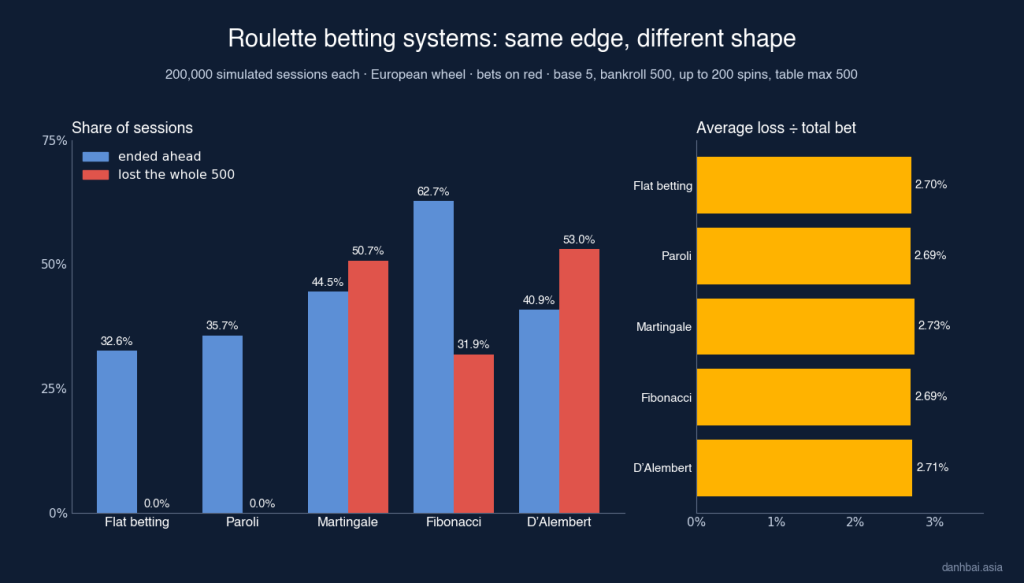
The systems change the shape of the results, not the cost. The Martingale and the Fibonacci end ahead more often than flat betting, because they recover small losses with one win, but they lose the whole bankroll in a large share of sessions: half of the Martingale sessions lost the 500. The D’Alembert raises the stake one unit after each loss and, over 200 spins, ends up betting far more, so it lost the most. In every case the average loss came to about 2.70% of everything bet, which is the house edge of a European wheel: a system that bets more loses more. Our roulette strategies page explains each system in detail.
A stop target changes the picture again. The same Martingale with a rule to stop as soon as the session is 50 ahead ended ahead in 88.8% of sessions, lost the 500 in 11.1%, and lost 11.03 on average, again 2.7% of the 411 it bet per session on average. Many small wins and a few large losses add up to the same edge.
The Martingale, worked out exactly
The plain Martingale can be calculated without a simulation. You bet one unit on red, double after each loss and stop at the first win, which is always one unit ahead. If the bankroll covers six losses in a row (1 + 2 + 4 + 8 + 16 + 32 = 63 units), the session fails only if the first six spins all lose:
| Losses covered | Bankroll (units) | Wins 1 unit | Loses the bankroll | Average result (units) |
|---|---|---|---|---|
| 3 | 7 | 86.46% | 13.54% | −0.083 |
| 4 | 15 | 93.05% | 6.95% | −0.113 |
| 5 | 31 | 96.43% | 3.57% | −0.143 |
| 6 | 63 | 98.17% | 1.83% | −0.174 |
| 7 | 127 | 99.06% | 0.94% | −0.205 |
| 8 | 255 | 99.52% | 0.48% | −0.238 |
| 9 | 511 | 99.75% | 0.25% | −0.271 |
| 10 | 1,023 | 99.87% | 0.13% | −0.306 |
A bigger bankroll makes the session fail less often but costs more when it does, and the average result gets worse, not better, because more is bet in each failed session. In the simulation above the bankroll ran out before the table maximum mattered: with a base bet of 5, six losses in a row (5 to 160) cost 315, and the seventh stake of 320 is more than the 185 left. A table maximum of 500 would have stopped the doubling at the eighth stake (640).
House edge by wheel
The edge is the share of every stake the casino keeps on average. On a European wheel it is 2.70% on every bet (1 in 37). On a French wheel with la partage, even-money bets cost 1.35% and the other bets 2.70%. On an American wheel it is 5.26% (2 in 38) on every bet except the five-number bet on 0, 00, 1, 2 and 3, which costs 7.89%. Switching the simulator to American and running a system again shows the average loss roughly doubling. The roulette calculator gives the payout, odds and edge of any combination of bets.
Playing roulette at 22bet
When you move from the simulator to real stakes, the same numbers apply. 22bet’s casino has computer-dealt European, American and French roulette from studios including NetEnt, Betsoft and Tom Horn, and live roulette tables from Evolution, Pragmatic Play, Ezugi and others. Choosing a single-zero wheel, and French roulette for even-money bets, keeps the edge at its lowest. Set a budget before you start and stop when it is gone.

22bet
Roulette Simulator: FAQ
Is this roulette simulator free?
Yes. It runs in your browser with a virtual balance; no account, no download and no money are involved.
Is the roulette simulator random?
Each spin is drawn from the browser’s cryptographic random number generator, with every pocket equally likely and no memory of earlier spins, the way a fair wheel behaves.
What is the order of numbers on a roulette wheel?
European wheel, clockwise from zero: 0-32-15-19-4-21-2-25-17-34-6-27-13-36-11-30-8-23-10-5-24-16-33-1-20-14-31-9-22-18-29-7-28-12-35-3-26. On the American wheel the 0 and 00 sit opposite each other, and every number faces its neighbour in counting order (1 opposite 2).
Does the Martingale work in roulette?
It wins small amounts often and loses the bankroll occasionally. Over 200,000 simulated sessions (base 5, bankroll 500, 200 spins on red) 44.5% ended ahead and 50.7% lost the whole 500, and the average loss was 2.7% of everything bet, the same as flat betting.
Which roulette wheel has the lowest house edge?
A single-zero wheel: 2.70% on European roulette, and 1.35% on even-money bets at French roulette with la partage. The American wheel with 0 and 00 costs 5.26%.
Can a betting system beat roulette?
No. Every spin has the same house edge whatever came before, so a system only changes how much is bet and how the results are spread; in the simulator each system loses about 2.7% of its total stakes on a European wheel.