


Gambler’s Fallacy: Why a Streak Never Makes a Result Due
November 13, 2026
The gambler’s fallacy is the belief that a result which has not come up for a while is “due”, or that a streak makes the opposite result more likely next time. After five reds in a row on a roulette wheel, black feels overdue. It is not: the wheel has no memory, and the chance of red on the next spin is exactly what it was on the first. The simulator below plays up to a million rounds of a coin, a roulette wheel or a die and shows what actually happened after every length of streak.
The simulator needs JavaScript. The tables below come from the same calculation.
What the gambler’s fallacy is
When rounds are independent, what happened before has no effect on what happens next. A fair coin, a roulette wheel and a die are independent: the coin does not know it landed heads four times, and the ball does not know which pockets it fell into before. The fallacy is to treat them as if they balance out in the short run, so that a run of one result has to be “paid back” by the other.
The name comes from the casino, but the same mistake shows up everywhere: picking lottery numbers that have not been drawn for a while, expecting a girl after three boys, or raising a bet after a losing run because a win “must” come. Its mirror image is the hot-hand fallacy, believing that a streak will continue because it is a streak. In an independent game both are wrong for the same reason.
After a streak of reds: what came next
This is a single-zero wheel played 10,000,000 times with the simulator above. Each spin is sorted by how many reds came right before it. If streaks mattered, the share of reds would fall (or rise) as the streak gets longer. It stays at the 48.65% chance of red on any spin, give or take the noise that comes with smaller counts:
| What came before | Spins | Next spin red | Share red |
|---|---|---|---|
| After black or zero | 5,132,989 | 2,498,005 | 48.67% |
| After 1 red in a row | 2,498,005 | 1,215,772 | 48.67% |
| After 2 reds in a row | 1,215,772 | 591,407 | 48.64% |
| After 3 reds in a row | 591,407 | 288,108 | 48.72% |
| After 4 reds in a row | 288,108 | 140,835 | 48.88% |
| After 5 reds in a row | 140,835 | 68,184 | 48.41% |
| After 6 reds in a row | 68,184 | 33,295 | 48.83% |
| After 7 reds in a row | 33,295 | 16,230 | 48.75% |
| After 8 reds in a row | 16,230 | 7,895 | 48.64% |
| After 9 reds in a row | 7,895 | 3,803 | 48.17% |
| After 10 or more reds in a row | 7,280 | 3,477 | 47.76% |
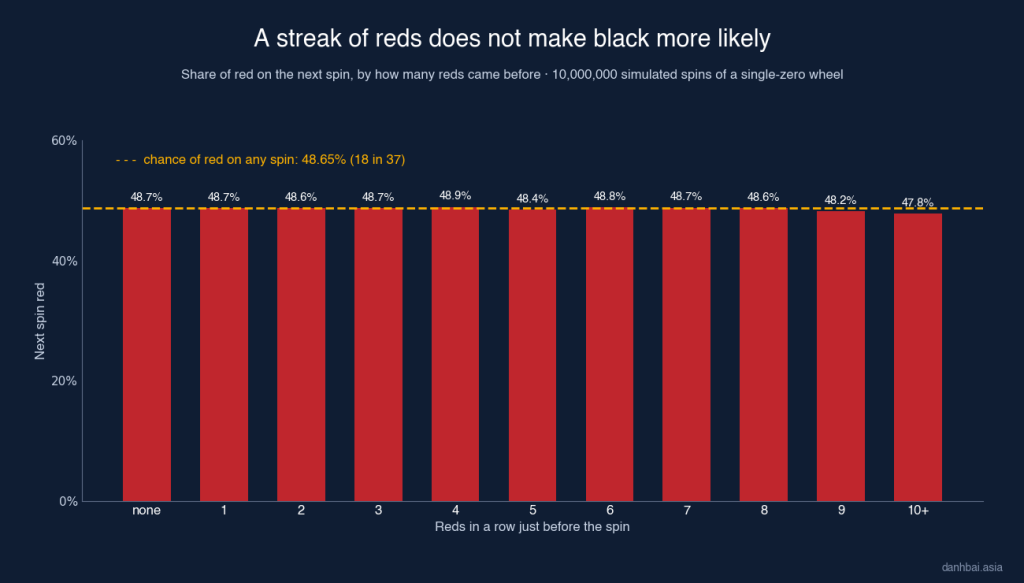
The longest run of reds in those 10,000,000 spins was 23. Long runs are not a sign that something is wrong with the wheel; in a long enough session they are certain to happen.
The Monte Carlo story
The fallacy is also called the Monte Carlo fallacy after the best-known example: on 18 August 1913, at the casino in Monte Carlo, black is said to have come up 26 times in a row, and players lost heavily betting on red as the run went on, sure that it had to end. On a single-zero wheel the chance of 26 blacks starting from a given spin is (18/37)26, about 1 in 136.8 million. The chance of black on the 27th spin was still 18 in 37.
How likely is a long run?
Streaks feel rare because the chance of a run starting at one particular spin is small. But a session gives the run many places to start. The chance of seeing at least one run of reds of a given length somewhere in a session, on a single-zero wheel (exact, not simulated):
| Run | In 100 spins | In 500 spins | In 1,000 spins |
|---|---|---|---|
| 5 reds in a row | 77.0% | over 99.9% | over 99.9% |
| 6 reds in a row | 49.5% | 97.1% | over 99.9% |
| 7 reds in a row | 27.5% | 81.4% | 96.6% |
| 8 reds in a row | 14.2% | 55.4% | 80.3% |
| 10 reds in a row | 3.5% | 17.2% | 31.6% |
| 12 reds in a row | 0.8% | 4.3% | 8.6% |
Over 500 spins, a run of eight reds turns up 55% of the time, and over 1,000 spins a run of ten reds 32% of the time. The same is true of black. A player watching the scoreboard will see runs like these regularly, and none of them says anything about the next spin. With a fair coin, 1,000 tosses produce a run of ten or more heads 38.5% of the time.
The law of averages, and what it really says
The law of large numbers is real: over many rounds, the share of each result settles close to its probability. The “law of averages” in everyday talk adds something that is not true, that the results have to catch up. They do not catch up; earlier results are simply outweighed by the far larger number of later ones. In fact the raw gap between heads and tails tends to grow with more tosses, while the percentage gap shrinks:
| Coin tosses | Average gap between heads and tails | Average gap from 50% heads |
|---|---|---|
| 100 | 8.0 | 3.98% |
| 10,000 | 79.8 | 0.399% |
| 1,000,000 | 797.9 | 0.0399% |
After 100 tosses the two sides are typically about 8 apart; after a million, about 800 apart. A player waiting for heads and tails to even out can wait forever. What the long run does guarantee is the house edge: on a single-zero roulette wheel the casino keeps 2.70% of everything bet over time, whatever the streaks. Our house edge page explains the figure for each game.
Betting systems built on the fallacy
Many betting systems quietly assume that a losing run makes a win more likely. The Martingale doubles the stake after each loss to win back everything with one win; others wait for a colour to be “overdue” before betting on it. Because each spin is independent, none of them changes the edge: they change how often a session ends ahead and how large the losing sessions are. You can test them over thousands of sessions in our roulette simulator, and our roulette strategies page goes through each system.
The same goes for scoreboards. Live roulette and baccarat tables show the last results, and some players read patterns into them. Our page on the baccarat scoreboard explains what the roads show and why they do not predict the next hand.
When the past does matter: cards
Not every game is independent. When cards are dealt from a shoe without being put back, every card that comes out changes what is left. From a full single deck the chance that the next card is an ace is 4 in 52 (7.7%). If three aces have already come out in the first ten cards, it is 1 in 42 (2.4%). That is why card counting can work in blackjack dealt from a shoe, and why it does not work at a table that shuffles after every hand. Most computer-dealt card games deal from a freshly shuffled deck each round, which makes every hand independent again. Our blackjack strategy page covers the game in more detail.
Slot machines do not “warm up” or become due either. Each spin of a slot is a fresh draw from its random number generator, so a machine that has not paid for a while is no closer to paying than one that just did. See what RTP means for how a slot’s return works over the long run.
Playing with the fallacy in mind
Knowing that streaks mean nothing is useful at the table: there is no reason to raise a stake after a run of losses, to chase a result that is “overdue”, or to stay longer because a win “has to” come. Decide on a budget and a stopping point before you start, and keep the stake the same whatever the scoreboard shows. If you play roulette, a single-zero wheel at 22bet keeps the edge at 2.70%, and at French roulette, even-money bets cost 1.35%.

22bet
Gambler’s Fallacy: FAQ
What is the gambler’s fallacy?
The belief that a result which has not happened for a while is due, or that a streak makes the opposite result more likely next. In independent games such as roulette, dice and coin tosses, every round has the same chances whatever came before.
After 10 reds in a row, is black more likely?
No. On a single-zero wheel the chance of black is 18 in 37 on every spin. In 10 million simulated spins, the spin after ten or more reds in a row was red 47.8% of the time, within the noise of the 48.65% chance on any spin.
Why is it called the Monte Carlo fallacy?
On 18 August 1913 at the Monte Carlo casino, black is said to have come up 26 times in a row while players bet heavily on red. The chance of that run from a given spin is about 1 in 137 million, and the chance of black on the next spin was still 18 in 37.
Is the law of averages real?
The law of large numbers is: over many rounds, the share of each result gets close to its probability. Results do not catch up, though. After a million coin tosses heads and tails are typically about 800 apart, even though the share of heads is within 0.04% of 50%.
What is the opposite of the gambler’s fallacy?
The hot-hand fallacy: believing a streak will continue because it is a streak. In independent games it is wrong for the same reason.
Does the gambler’s fallacy apply to blackjack?
Not fully. Cards dealt from a shoe are not put back, so the cards already seen change what is left, which is why card counting exists. At tables that shuffle every hand, as most computer-dealt games do, each hand is independent.