


Three Card Poker: Rules, Payouts, Odds and Strategy
November 4, 2026
Three Card Poker is one of the quickest poker games in a casino: you and the dealer get three cards each, you make one decision, and the hand is over. It is really two games on one table. Ante and Play is a showdown against the dealer’s hand; Pair Plus is a bet on your own three cards that ignores the dealer completely. You can play either one or both.
Every figure on this page — how often each hand comes up, the house edge of each bet and the strategy cut-off — comes from working through all 22,100 three-card hands against every possible dealer hand.
How to play Three Card Poker
- Place your bets. An Ante, a Pair Plus bet, or both. Many tables add an optional 6 Card Bonus side bet.
- The deal. You and the dealer each receive three cards from a single 52-card deck. The dealer’s cards stay face down.
- Play or fold. If you made an Ante bet, you either fold and lose the Ante, or place a Play bet equal to the Ante.
- The dealer reveals and checks whether the hand qualifies: it needs queen-high or better.
- Settlement of Ante and Play is below. Pair Plus and the Ante Bonus pay on your hand alone, whatever the dealer holds.
| Result | Ante | Play |
|---|---|---|
| Dealer does not qualify (less than queen-high) | Wins 1 to 1 | Returned (push) |
| Dealer qualifies, your hand is better | Wins 1 to 1 | Wins 1 to 1 |
| Dealer qualifies, hands are equal | Returned | Returned |
| Dealer qualifies, the dealer’s hand is better | Loses | Loses |
The dealer fails to qualify on 30.4% of deals. Queen-high is the lowest qualifying hand, so Q-3-2 qualifies and J-10-8 does not.
Three Card Poker hand rankings
With only three cards, the order differs from ordinary five-card poker: a straight beats a flush, because there are fewer ways to make three cards in a row than three of one suit. There is no two pair, full house or four of a kind. The five-card order used by most other poker games is on our poker hands page.
| Hand | Example | Combinations | Chance |
|---|---|---|---|
| Straight flush | 7♥ 8♥ 9♥ | 48 | 0.22% (1 in 460) |
| Three of a kind | K♠ K♦ K♣ | 52 | 0.24% (1 in 425) |
| Straight | 4♣ 5♦ 6♠ | 720 | 3.26% (1 in 31) |
| Flush | 2♦ 9♦ J♦ | 1,096 | 4.96% (1 in 20) |
| Pair | 8♠ 8♥ A♣ | 3,744 | 16.94% (1 in 6) |
| High card | K♥ 9♣ 4♦ | 16,440 | 74.39% |
Aces count high or low in a straight: A-K-Q is the highest straight and A-2-3 the lowest. Between two hands of the same type, the higher cards win, compared from the top down; suits never break a tie. If you know how hands rank in standard poker, our poker guide covers the five-card order.
Three Card Poker payouts
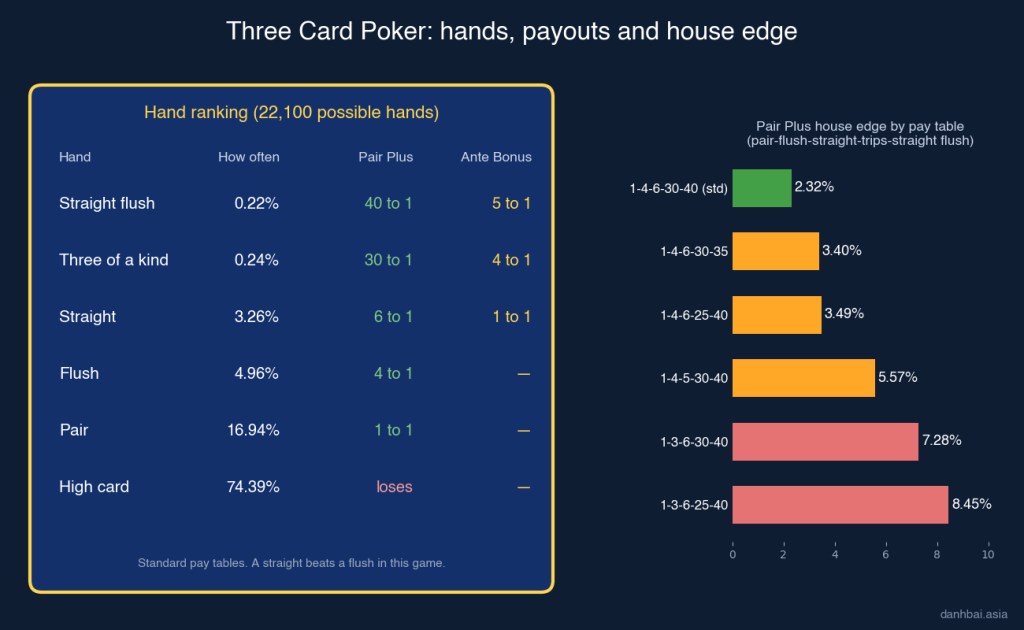
These are the standard pay tables used in US casinos. Online and live versions often use their own, so check the paytable on the screen before you bet — the Pair Plus table in particular varies, and it changes the house edge a lot.
| Your hand | Pair Plus pays | Ante Bonus pays |
|---|---|---|
| Straight flush | 40 to 1 | 5 to 1 |
| Three of a kind | 30 to 1 | 4 to 1 |
| Straight | 6 to 1 | 1 to 1 |
| Flush | 4 to 1 | — |
| Pair | 1 to 1 | — |
The Ante Bonus is paid automatically on a straight or better if you made the Play bet — even when the dealer beats you or fails to qualify. Across all hands it returns about 5.3% of your Ante.
Three Card Poker strategy: Q-6-4
The whole strategy fits in one line: play with queen-6-4 or better, fold anything lower. That means play every pair or better, every hand with a king or an ace, and queen-high hands from Q-6-4 upward. Fold Q-6-3, Q-5-4 and everything jack-high or lower.
It sounds cautious, but the arithmetic is tight: folding always costs exactly 1 Ante, and the Q-6-4 rule matches the best possible decision on every one of the 22,100 hands. You end up playing 67.4% of hands and folding 32.6%.
| Your hand | Average result of playing (per Ante) | Folding | Decision |
|---|---|---|---|
| K-3-2 | −0.55 | −1 | Play |
| Q-J-2 | −0.74 | −1 | Play |
| Q-6-5 | −0.987 | −1 | Play |
| Q-6-4 | −0.994 | −1 | Play (just) |
| Q-6-3 | −1.003 | −1 | Fold (just) |
| Q-6-2 | −1.013 | −1 | Fold |
| J-9-8 | −1.14 | −1 | Fold |
The averages are over every dealer hand and every suit combination. The gap between Q-6-4 and Q-6-3 is less than one hundredth of an Ante, so getting the cut-off slightly wrong costs very little — but playing everything does not:
| Strategy | House edge (per Ante) |
|---|---|
| Play Q-6-4 or better (best possible) | 3.37% |
| Play any queen-high or better (“mimic the dealer”) | 3.45% |
| Play king-high or better only | 4.99% |
| Play every hand | 7.65% |
House edge and odds
With the Q-6-4 strategy and the standard Ante Bonus, Ante and Play has a house edge of 3.37% of the Ante. Because you add the Play bet on two hands in three, your average total stake is about 1.67 Antes, so the expected loss is about 2.01% of the money you actually bet — one of the lower figures on a casino table.
Here is what happens to an Ante over the long run when you follow Q-6-4:
| Outcome | Share of hands |
|---|---|
| You fold | 32.58% |
| You play, the dealer does not qualify (Ante wins, Play returned) | 21.00% |
| You play and beat a qualifying dealer | 23.91% |
| You play and lose to a qualifying dealer | 22.45% |
| You play and tie | 0.07% |
Pair Plus needs no strategy at all — it pays on your three cards — so its house edge depends only on the pay table. On the standard 1-4-6-30-40 table (pair, flush, straight, three of a kind, straight flush) it is 2.32%. Cutting the flush from 4 to 1 down to 3 to 1 more than triples it:
| Pair Plus table | House edge |
|---|---|
| 1-4-6-30-40 (standard) | 2.32% |
| 1-4-6-30-35 | 3.40% |
| 1-4-6-25-40 | 3.49% |
| 1-4-5-30-40 | 5.57% |
| 1-3-6-30-40 | 7.28% |
| 1-3-6-25-40 | 8.45% |
These figures match the Wizard of Odds (Michael Shackleford) analysis of the game. No strategy changes the house edge of Pair Plus; the only decision that matters is which table you sit at. At the simple end of the scale, Casino War asks for one decision only, when the two cards tie, and in Red Dog the only choice is whether to double your bet. For comparison, Caribbean Stud Poker, the five-card version of a game against the dealer, has a house edge of 5.22% of the ante with perfect play, and Mississippi Stud, a five-card game played against a pay table instead of the dealer, 4.91%; Let It Ride, where you start with three bets and can take two back, 3.51% of one bet; and High Card Flush, where seven cards each are compared by their longest flush, 2.71% of the Ante.
Three Card Poker vs Teen Patti, Liêng and Bài Cào
Three-card games have a long history in Asia, and the hand order will look familiar if you know them. Teen Patti ranks hands the same way (trail, pure sequence, sequence, colour, pair, high card) but is played between players with rounds of betting rather than one decision against the dealer. Vietnam’s Liêng is another player-versus-player three-card game with its own hand order, and Bài Cào counts card points rather than poker hands. Three Card Poker is the casino version: a fixed pay table, a dealer who has to qualify, and no bluffing.
Three Card Poker online
20Bet’s live casino lists Three Card Poker and Triple Card Poker in its poker lobby, dealt by a real dealer on a video stream, alongside Caribbean Stud, Ultimate Texas Hold’em and Teen Patti tables. Its casino lobby adds RNG versions — Three Card Poker, Three Card Poker Deluxe and Triple Edge Poker — for quicker hands without a dealer. 22bet runs Habanero’s Three Card Poker as a random-number-generator game. Live and RNG versions can use their own pay tables and side bets, so read the game’s help screen before you start.
Play responsibly
Three Card Poker is for players aged 18 and over. A hand takes seconds, which makes it easy to play many more hands per hour than you intended, and the house edge applies to every one of them. Set a budget before you sit down and stop when it is spent.

20Bet
Three Card Poker FAQ
How do you play Three Card Poker?
Place an Ante, a Pair Plus bet or both, and receive three cards. With an Ante, either fold or add a Play bet equal to the Ante. The dealer needs queen-high or better to qualify: if not, the Ante wins and the Play is returned; if so, the better hand wins both bets. Pair Plus pays on your own hand only.
What is the best strategy in Three Card Poker?
Play with queen-6-4 or better and fold anything lower. This rule matches the best possible decision on every hand and gives a house edge of 3.37% of the Ante.
What does the dealer need to qualify in Three Card Poker?
Queen-high or better. The dealer fails to qualify on about 30.4% of deals; when that happens your Ante wins even money and your Play bet is returned.
What is the house edge in Three Card Poker?
Ante and Play: 3.37% of the Ante with the Q-6-4 strategy, about 2.01% of the total amount bet. Pair Plus: 2.32% on the standard 1-4-6-30-40 pay table, rising to 7.28% when a flush pays 3 to 1.
Does a straight beat a flush in Three Card Poker?
Yes. With three cards there are 720 ways to make a straight and 1,096 ways to make a flush, so the straight is rarer and ranks higher.
What is the Ante Bonus?
An automatic extra payout on the Ante when you hold a straight or better and made the Play bet: 1 to 1 for a straight, 4 to 1 for three of a kind and 5 to 1 for a straight flush on the standard table. It is paid even if the dealer beats you.
Is Pair Plus a good bet?
It depends entirely on the pay table. On the standard 1-4-6-30-40 table the house edge is 2.32%; on a 1-3-6-30-40 table it is 7.28%. No strategy changes it, so check the table before betting.
Can you play Three Card Poker online?
Yes. 20Bet’s live casino lists Three Card Poker and Triple Card Poker tables, its casino lobby has RNG Three Card Poker, Three Card Poker Deluxe and Triple Edge Poker, and 22bet runs Habanero’s RNG Three Card Poker.