


How to Play Craps: Rules, Table Layout and Bets for Beginners
November 5, 2026
Craps looks like the busiest table in a casino: a long felt layout covered in boxes, a crowd shouting, chips moving after every roll. Under all of that sits a simple game. One player, the shooter, rolls two dice; everyone else bets on what those dice do. Learn the pass line and the round it follows, and you can play the whole game. Everything else on the table is optional.
This guide walks through one round of craps from the first roll to the last, explains every area of the craps table, and works out how long a shooter’s turn lasts. All the percentages come from the 36 ways two dice can land.
Craps in 30 seconds
- Bet the pass line before the first roll of a round, the come-out roll.
- 7 or 11 on the come-out wins at once. 2, 3 or 12 (“craps”) loses at once.
- Any other total (4, 5, 6, 8, 9 or 10) becomes the point. The dealer marks it with the puck.
- The shooter keeps rolling. Point before 7: the pass line wins even money. 7 before the point (the “seven-out”): it loses, and the dice pass to the next shooter.
That is the game. Free odds, come bets and the rest of the layout are extra bets built around this one round.
The craps table layout explained
A land-based craps table is two identical halves with the centre bets in the middle, so players at either end can reach the same bets. Here is one end:
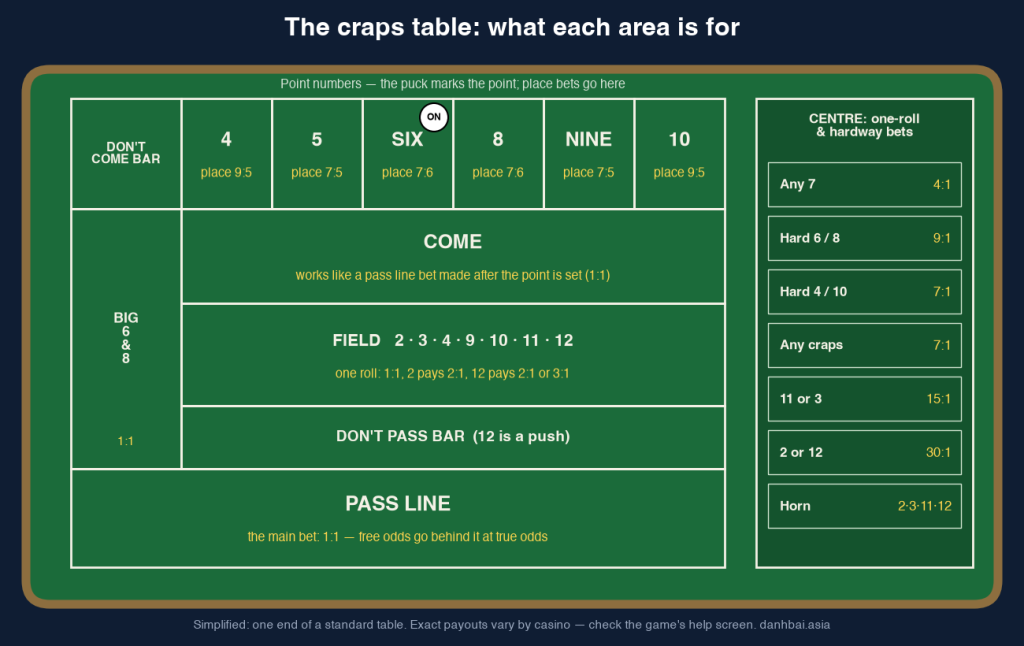
- Pass line — the long strip nearest the players and the main bet of the game. Free odds bets sit just behind it.
- Don’t pass bar — the opposite bet: it wins when the pass line loses, except that a 12 on the come-out is a push.
- Come / don’t come — the same two bets, placed after a point is already set.
- Point numbers (4, 5, SIX, 8, NINE, 10) — where the puck marks the point, where come bets are moved once they have their own number, and where place bets go.
- Field — a one-roll bet on 2, 3, 4, 9, 10, 11 or 12.
- Big 6 and Big 8 — even-money bets that a 6 or an 8 rolls before a 7.
- Centre — the proposition bets: hardways and one-roll bets such as any 7, any craps, 11 and the horn.
At a land-based table the game is run by a crew: the stickman moves the dice with a stick and calls each roll, two base dealers pay and collect bets on their side of the table, and the boxman supervises and handles the chips. Online and in live-dealer games the software settles every bet, but the layout and the rules are the same.
Step 1: the come-out roll
A round starts with the come-out roll. Before it, the puck lies on its black “OFF” side, usually in the don’t come bar, to show there is no point yet. Two dice can land 36 ways, and that fixes the chance of every total:
| Total | Ways to roll it | Chance | On the come-out, the pass line… |
|---|---|---|---|
| 2 | 1 | 2.78% | loses (craps) |
| 3 | 2 | 5.56% | loses (craps) |
| 4 | 3 | 8.33% | point |
| 5 | 4 | 11.11% | point |
| 6 | 5 | 13.89% | point |
| 7 | 6 | 16.67% | wins (natural) |
| 8 | 5 | 13.89% | point |
| 9 | 4 | 11.11% | point |
| 10 | 3 | 8.33% | point |
| 11 | 2 | 5.56% | wins (natural) |
| 12 | 1 | 2.78% | loses (craps) |
Added up: the come-out wins the pass line 22.2% of the time (2 in 9), loses it 11.1% (1 in 9), and sets a point the other 66.7% (2 in 3). After a 7, 11, 2, 3 or 12 the same shooter simply rolls a new come-out.
Step 2: the point
Once a point is set, the dealer turns the puck to its white “ON” side and puts it on that number. Now only two totals matter to the pass line: the point and 7. Every other roll leaves it in place. Because 7 can be rolled six ways and every point fewer, the pass line is the underdog at this stage. How much depends on the point:
| Point | Ways to roll it | Chance the point comes before a 7 | True odds against |
|---|---|---|---|
| 4 or 10 | 3 | 33.3% | 2 to 1 |
| 5 or 9 | 4 | 40.0% | 3 to 2 |
| 6 or 8 | 5 | 45.5% | 6 to 5 |
If the point rolls first, the pass line wins even money and the next roll is a new come-out with the same shooter. If a 7 rolls first, that is the seven-out: the pass line loses and the dice go to the next player. Note the difference: a 7 on the come-out wins the pass line; a 7 after a point is set loses it.
Pass line and don’t pass
Over a full round, come-out and point together, the pass line wins 244 times in 495 (49.29%) and costs 1.41% of each bet. A round takes 3.4 rolls on average.
Don’t pass is the same round from the other side. It wins on a 2 or 3 on the come-out, loses on a 7 or 11, and pushes on a 12 — the “bar 12” printed on the layout, which is what gives the house its edge. After a point is set it wins if the 7 comes first. It wins 47.93% of rounds, pushes 2.78% and costs 1.36%, slightly less than the pass line. Players who bet it are called “wrong” bettors, which is only table slang: the bet is as legitimate as the pass line.
Free odds: the bet with no house edge
Once there is a point, you can add a free odds bet behind your pass line bet. It is not marked on the layout. It pays the true odds from the table above — 2 to 1 on 4 or 10, 3 to 2 on 5 or 9, 6 to 5 on 6 or 8 — so the house has no edge on it at all. Each casino sets the maximum, as a multiple of your line bet. A common limit is 3-4-5x: three times the line bet on 4 or 10, four times on 5 or 9, five times on 6 or 8. With 3-4-5x odds a winning odds bet always pays six times the line bet, and the combined edge on everything you have on the table falls from 1.41% to 0.37%.
Don’t pass players can lay odds the same way: they put up more to win less (1 to 2 on 4 or 10, 2 to 3 on 5 or 9, 5 to 6 on 6 or 8), again at no house edge. Our craps payout calculator works out any odds bet for any line bet and point.
Come and don’t come
A come bet is a pass line bet made after the point is set. The next roll is its own come-out: 7 or 11 wins it, 2, 3 or 12 loses it, and any other number becomes the come bet’s own point. The dealer moves your chips onto that number, and from then on it wins if that number repeats before a 7. It pays even money, costs the same 1.41%, and takes free odds the same way. Players use come bets to have several numbers working at once. Don’t come is the mirror bet at 1.36%.
The other bets on the table
Everything else is optional, and most of it costs more than the line bets. A short guide, with what each bet costs:
| Bet | What it is | Pays | House edge |
|---|---|---|---|
| Place 6 or 8 | The number rolls before a 7; stays up until it does | 7 to 6 | 1.52% |
| Place 5 or 9 | Same, on 5 or 9 | 7 to 5 | 4.00% |
| Place 4 or 10 | Same, on 4 or 10 | 9 to 5 | 6.67% |
| Field | One roll: 2, 3, 4, 9, 10, 11 or 12 | 1 to 1; 2 pays 2 to 1; 12 pays 3 to 1 (or 2 to 1) | 2.78% (5.56% if 12 pays 2 to 1) |
| Big 6 / Big 8 | A 6 (or 8) before a 7 | 1 to 1 | 9.09% |
| Hard 6 / Hard 8 | 3+3 (or 4+4) before a 7 or the “easy” way | 9 to 1 | 9.09% |
| Hard 4 / Hard 10 | 2+2 (or 5+5) before a 7 or the easy way | 7 to 1 | 11.11% |
| Any craps | One roll: 2, 3 or 12 | 7 to 1 | 11.11% |
| 2 or 12 | One roll on that exact total | 30 to 1 | 13.89% |
| Any 7 | One roll: 7 | 4 to 1 | 16.67% |
Place 6 and 8 are the one exception worth knowing: at 1.52% they cost almost the same as the pass line. Big 6 and Big 8 are the same bet as placing the 6 or 8 at a worse payout. For the full layout, including buy and lay bets, horn and C&E, see our craps payout chart.
An example round, roll by roll
Say you bet 10 on the pass line at a table with 3-4-5x odds.
| Roll | Result | What happens |
|---|---|---|
| Come-out | 8 | 8 is the point; the puck goes ON the 8. You add 50 in free odds (5x). |
| 2nd | 11 | Nothing for the pass line. You put 10 on the come. |
| 3rd | 5 | Your come bet moves to the 5. You add 40 odds on it (4x). |
| 4th | 3 | Nothing happens to either bet. |
| 5th | 8 | Point made. Pass line wins 10; the odds pay 6 to 5, so 60. Profit 70. The puck goes OFF. |
| New come-out | 7 | A fresh 10 on the pass line wins 10. Your come bet on 5 loses its 10; its odds were “off” for the come-out roll, so the 40 comes back. |
Six rolls, net profit 70. The last line shows a rule that catches newcomers: at most tables, odds on come bets do not work on the come-out roll unless you ask the dealer to turn them on.
How long does a shooter’s turn last?
A shooter keeps the dice until they seven-out, however many points they make or come-out rolls they win along the way. Counting every possible sequence of rolls gives an exact answer:
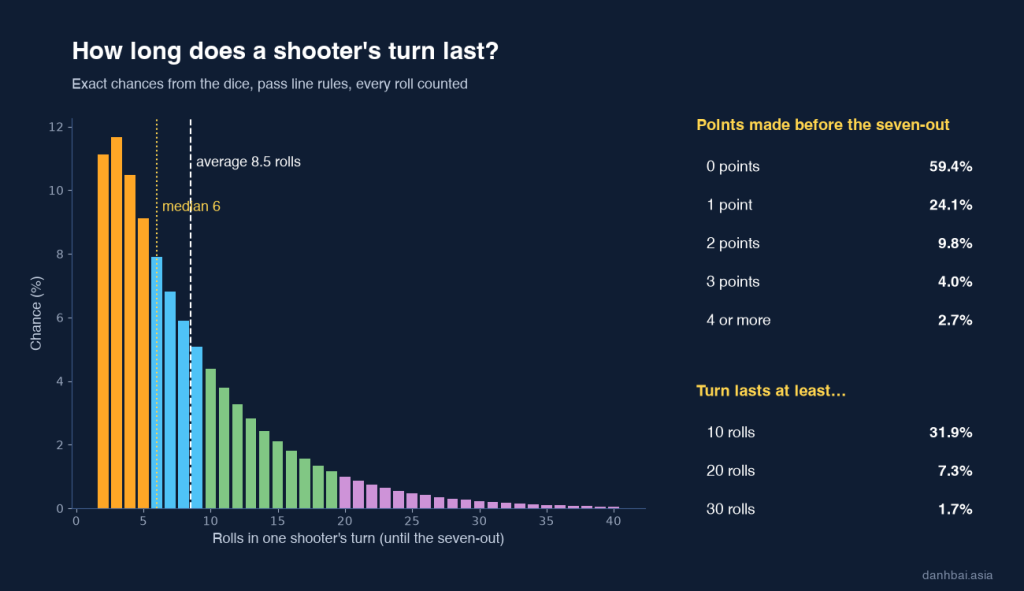
- The average turn lasts 8.5 rolls; the median is 6. A turn can never be shorter than two rolls (a point, then a 7).
- 59.4% of shooters seven-out without making a single point. 40.6% make at least one, 16.5% at least two, and 2.7% four or more.
- About one turn in three (31.9%) lasts 10 rolls or more, one in fourteen (7.3%) lasts 20 or more, and 1.7% reach 30.
Those long turns are the “hot rolls” craps players remember — and the numbers show why they feel special: they are rare, and every roll in them was still the same 36-way throw as the first.
Craps rules newcomers ask about
- Who rolls? At a land-based table the dice move clockwise around the table after each seven-out. You can pass the dice if you do not want to shoot, and you do not have to bet differently when you are the shooter.
- Throwing the dice. The shooter uses one hand and must hit the far wall of the table. If a die leaves the table, the roll does not count and the shooter rolls again.
- Can I take my bet down? Not a pass line or come bet once it has a point, because the bet is in your favour from the come-out roll and the house’s afterwards. Odds, place bets and don’t bets can be taken down or reduced.
- Table minimums. The sign on the table shows the minimum and maximum bet and the maximum odds. Online tables show the same limits in the game.
- Craps vs crapless craps. Some electronic and casino tables play a variant with no losing come-out numbers. It sounds friendlier and costs more: see our bubble craps and crapless craps guide.
Craps strategy for beginners: the bets that cost the least
No staking pattern or system changes the edge on any bet; the dice have no memory. What you choose is how much each bet costs, and the spread in craps is wide — from 0% to almost 17%:
- Pass line or don’t pass, 1.41% or 1.36%.
- Add free odds when a point is set. They cost nothing, so they lower the edge on your total stake.
- Come or don’t come if you want more numbers working, again with odds.
- Place 6 and 8 at 1.52% if you prefer place bets.
The centre bets pay the most and cost the most, between 9% and 17%. Set a budget before you play and stop when it is gone.
Playing craps online
22bet’s casino lists Evolution’s live Craps, Evolution’s RNG First Person Craps and Foxi’s Wild Craps. The live game is streamed from a studio and you bet on an on-screen layout; First Person Craps is a computer-animated version of the same game. Evolution’s games use the standard layout with pass, don’t pass, come and don’t come. Before you bet, open the game’s help screen to check its payouts and its maximum odds, because those can differ between games. Craps is for players aged 18 and over; play with money you can afford to lose.

22bet
How to play craps: FAQ
How do you play craps for beginners?
Bet the pass line before the come-out roll. A 7 or 11 wins, a 2, 3 or 12 loses, and any other total becomes the point. The shooter then keeps rolling: if the point comes again before a 7, the pass line wins even money; if a 7 comes first, it loses.
What are the basic rules of craps?
One player rolls two dice and everyone bets on the result. Each round starts with a come-out roll that either settles the pass line at once (7 or 11 wins, 2, 3 or 12 loses) or sets a point. After that only the point and 7 matter to the pass line. The shooter keeps the dice until a 7 rolls after a point is set, the seven-out.
What does the puck mean in craps?
The puck shows whether a point is set. Black side up (OFF), the next roll is a come-out roll. White side up (ON) and sitting on a number, that number is the point.
What is the best bet in craps?
The pass line or don’t pass, at 1.41% and 1.36%, with free odds added once a point is set. The odds bet pays true odds and has no house edge, so the more odds you take, the lower the edge on your total bet: 0.37% with 3-4-5x odds.
Does a 7 win or lose in craps?
Both, depending on when it rolls. On the come-out roll a 7 wins the pass line. After a point is set, a 7 loses it and ends the shooter’s turn.
What are 3-4-5x odds in craps?
A free odds limit: you can bet up to three times the pass line bet when the point is 4 or 10, four times on 5 or 9 and five times on 6 or 8. A winning odds bet then always pays six times the line bet.
How many rolls does a craps shooter get?
As many as it takes to seven-out. The average turn lasts 8.5 rolls and the median is 6; 59.4% of shooters seven-out without making a point, and about one turn in three lasts 10 rolls or more.
Can you play craps online?
Yes. 22bet’s casino lists Evolution’s live Craps, Evolution’s First Person Craps and Foxi’s Wild Craps. Check each game’s help screen for its payouts and maximum odds.